Saint Paul, the Greatest Ancient Writer: Part 2
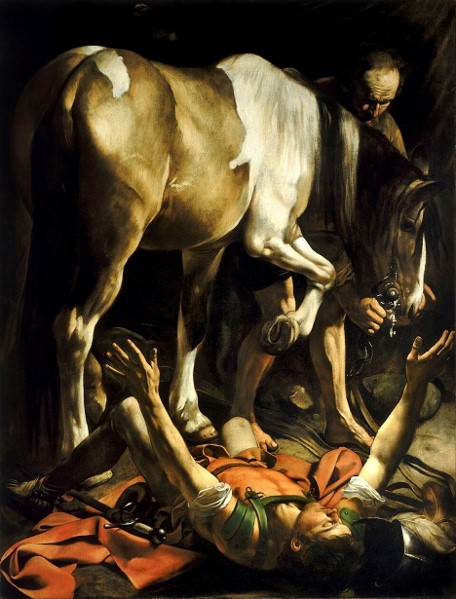
In early August, Dana and I were privileged to attend a friend’s milestone birthday party. There I was seated at dinner next to a superb painter whose work I’ve always admired. (She’s a wonderful writer, too.) In the course of conversation she mentioned that her favorite painting is The Conversion of Saint Paul (1601) by Caravaggio. This came as a surprise to me because in more than twenty-five years of friendship I’ve never heard her mention religion. Of course, I quickly reminded myself, you don’t have to be religious to like religious paintings. You don’t even have to be religious to appreciate the religious context and message—if there is one—of the work.
When I asked my friend later why the Caravaggio is her favorite painting, she said,
“I love the composition—the darks and lights are like the best of Franz Kline. I love that the very biggest part of the composition is a horse’s rump—which makes me laugh, but it is a comment on Paul, too, who was a rampant unbeliever. I love the tenderness of the groom as he cares for the horse and his indifference to Paul’s great vision—the groom comforts the horse with a touch on his nose. The horse is wary but comforted and maybe turning his interest to something else. I love the way the groom is painted. His forehead! His toe! So tender. But perhaps most especially I love the vulnerability of Paul. He is beautiful in his state of transportation. He is abject, but he is not a fool; he is a warrior, but he is full of love.”
Intrigued, I asked another friend of mine, a retired art historian whose scholarship and insights are impeccable, for his take on the painting. He replied, “It’s the beginning of the anti-ornate realistic trend in seventeenth-century painting. For some art historians it is the beginning of modern art—art made from life rather from inherited formulas and textual traditions.” Referring to Tintoretto’s 1544 painting of the same event, he added, “Caravaggio is simplifying [Tintoretto’s] overly theatrical representation—keeping it real.”
It seems to me that both my friends are saying the same thing. If Caravaggio hadn’t been keeping it real, my painter friend wouldn’t have been so moved.
Don’t we find that in Paul’s writing, too? He was nothing if not a warrior. He was nothing if not a shedder of inherited textual traditions. Despite the difficulty, the abstraction, the rhetoric, the all-over-the-place sentences of his epistles, Paul brings Jesus down to earth yet again.
And the painting reminds us of what we read in our July 19 lectionary from Romans 8: Hope that is seen is not hope. For who hopes for what is seen? Certainly not a blinded man.
Barbara