
The word agape has been on my mind lately. First, because of the highly successful Agape Fund Bake Sale last weekend! Second, because of the dire need for more agape (Christlike) love in our world. And third, because of all the premarital counseling I’ve been doing lately. Let me explain.
Eros love is the love of romance. Philia love is the love of friendship. Both are loves that are based on our feelings or preference for another person. Agape love, in contrast, is based on God’s command to love our neighbor. And who is our neighbor? Everyone, enemies included. It is the love of Christian duty grounded in our love of God and commitment to follow Jesus.
In his book Works of Love, Danish theologian Søren Kierkegaard argues that agape love is essential for a marriage to be secure. Why? Because romantic love alone is inherently unstable and prone to emotional chaos. “The love which simply exists, however fortunate, however blissful, however satisfying, however poetic it is, still must survive the test of the years. But the love which has undergone the transformation of the eternal by becoming duty has won continuity.” (p. 47).
Friendships – indeed, all relationships – benefit from agape love too. It’s the glue that holds them together when feeling isn’t enough. Kierkegaard writes of God as a “middle term” connecting two people. (p. 58) Other scholars have used these words to invoke the image of an equilateral triangle with God at the top point, the self at the bottom left point, and the other person (whether that be neighbor/lover/friend) at the bottom right point.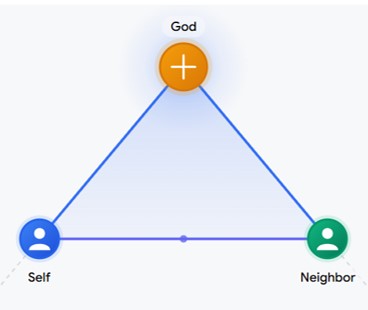 In choosing how to relate or react to someone, we can build a path along the bottom of the triangle. This might work out just fine, or it might not. Again, human emotions are all over the place, and this horizontal path could end up being driven by selfish desires, codependency, or negativity.
The other option is to build a path that goes through God. That could mean stopping short of saying something unkind because you’ve run into God on your way to responding to someone who offended you. It could mean picking up the phone to call your parents because God says to honor your father and mother. (I doubt my daughter at college is reading this, but, hey, you never know.) Or it could mean answering a request for help when you “just don’t have the time.” As is often the case, you may find that loving action leads to loving emotion.
The point is to center God in our relationships just as we seek to center God in our lives. It’s hard work, to be sure. But love, it turns out, hangs on a command.
Adrian+