
Saint Paul, the Greatest Ancient Writer: Part 1
In 1986, the great literary critic Harold Bloom wrote an article published on the front page of The New York Times Book Review entitled “Freud, the Greatest Modern Writer.” In it, Bloom makes a very strong case for Freud’s literary genius, and no matter what you think of Freud—or Bloom—it’s hard to dispute Bloom’s assertion that “all of Freud’s copious writing is intensely metaphorical, very little of it is verifiable, and much of it is devoted to what cannot be described.”
Hmm. Does that remind you of anyone?
Saint Paul’s epistles are also intensely metaphorical, almost entirely unverifiable, and devoted to what cannot be described. That’s why for the last thirty years I’ve been desperate to read from the epistles during the service of holy eucharist whenever it’s my turn to serve at the altar or during morning prayer as a reader. Sure, the Old Testament is great, but those epistles—sometimes their language can only be untangled by reading them out loud. I’m a sucker for complexity and abstraction and lengthy sentences anyway.
Consider the following passage from Romans 8, which appeared in our lectionary on July 19.
For the creation waits with eager longing for the revealing of the children of God; for the creation was subjected to futility, not of its own will but by the will of the one who subjected it, in hope that the creation itself will be set free from its bondage to decay and will obtain the freedom of the glory of the children of God. We know that the whole creation has been groaning in labor pains until now; and not only the creation, but we ourselves, who have the first fruits of the Spirit, groan inwardly while we wait for adoption, the redemption of our bodies. . . . Now, hope that is seen is not hope. For who hopes for what is seen?
Whew—we’ve got it all there: metaphor (the creation as a woman giving birth), lack of verifiability (the creation will be set free), and devotion to the indescribable (the unseen). We’ve also got abstraction: Creation was subjected to . . . “futility”? The “freedom of the glory of the children of God”? What’s that? Yet Paul plows ahead—he can’t let a sentence end without making sure he’s driven the point home by using as many examples and qualifications and digressions as necessary—as if to say, “Pay attention! Stay with me! I insist!”
There’s another assertion Bloom makes about Freud that strikes me as true of Paul: “He is a powerful rhetorician, a subtle ironist. . . . His general theory of the mind not only has the speculative force of a great metaphysician, like Plato, but it also has the personal moral urgency of the greatest of essayists, Montaigne, and an astonishingly Shakespearean eloquence as well.”
This beauty from Philippians 4 proves that point:
Finally, brethren, whatever is true, whatever is honorable, whatever is just, whatever is pure, whatever is lovely, whatever is gracious, if there is any excellence, if there is anything worthy of praise, think about these things. What you have learned and received and heard and seen in me, do; and the God of peace will be with you.
Do we need any more reasons to crown Paul the greatest ancient writer? He wrote from the heart, as it occurred to him, channeling every passion he had through his pen. The pure poetry of his work demands that we listen.
Barbara

Unknown artist, Saint Paul Writing His Epistles, ca. 1618–20
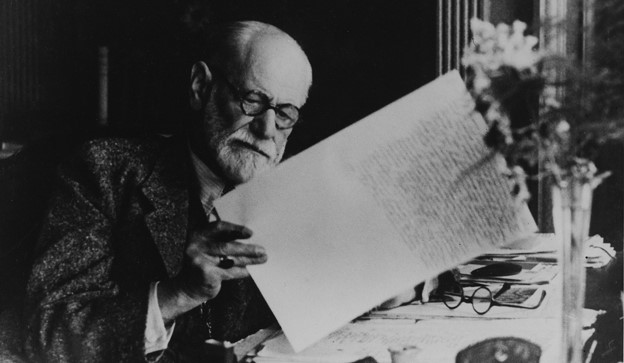
Freud at his desk in London, 1938